
Why the Arts & Crafts Movement Still Matters to Me

Notes from Fishponds
If you've ever looked closely at the MIF Soap Co logo, you might have spotted a clue to something I have loved for a very long time. The typeface has a definite nod to the Arts & Crafts movement.
I've always been drawn to that period. Not simply because the things produced were beautiful, although they absolutely were, but because of the thinking behind them. The tools, the skills, the craftsmanship and the belief that the person making something actually mattered and deserved to be celebrated.
There is something very satisfying about an object that has clearly passed through somebody's hands. And I think that's probably why it feels so familiar to me.
A house by the Thames
A couple of years ago I visited Emery Walker's House at 7 Hammersmith Terrace in London. If Arts & Crafts is your thing, put it on your list.
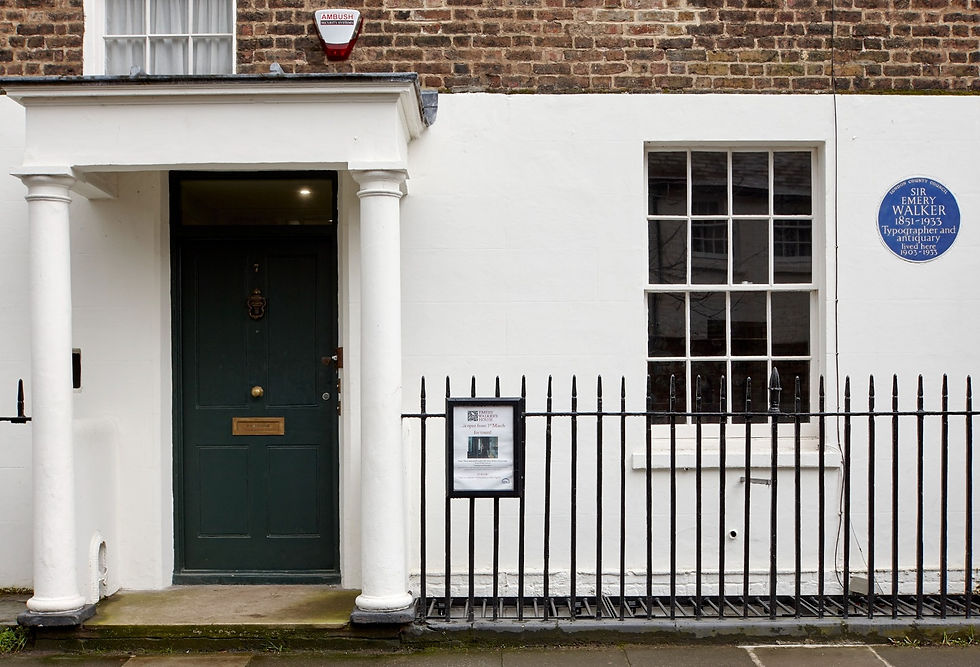
Emery Walker was a printer, photographer and close friend of William Morris, and the house is extraordinary because it still feels like a home rather than a museum. It's full of Morris & Co wallpapers and textiles, furniture by designers of the period, books, ceramics, and all sorts of things collected and lived with by the Walker family. It feels like his daughter (who lived there last) has just stepped out for a mo and left the door ajar so you can have a peek.
And then you step outside into the garden, which runs down towards the wall overlooking the Thames. It's quite something to stand there and imagine this little pocket of Hammersmith when Walker, Morris and their circle of artists, printers, designers, and craftspeople were living and working around one another.

Inside the house, beneath the rugs in the hallway, is also believed to be the only surviving example of Morris lino still in its original domestic setting. It's these details that I love. Not just the famous finished designs, but the experiments, prototypes, printing blocks, tools and evidence of people making things, some of which never got made commercially, but that's art, right?
What has any of this got to do with soap?
Quite a lot, as it happens.
One of the things at the heart of the Arts & Crafts movement was a reaction against mass production and the separation of the maker from the thing being made. That struck a chord with me long before I thought about connecting it with MIF.
I make in small batches because I want to know what's happening. I want to see the texture, smell it, feel it, watch it change and have tight control over what eventually leaves my workshop.
There's a practical reason for small batches, of course, but there's pleasure in it too.
Making soap is a bit like making bread.
You can't really rush either process and neither should you if you want to end up with something to be proud of.
There are stages when you have something to do and stages when you simply must leave it alone. Soap, like bread, goes at its own pace.
I rather like that.
It gives you time and headspace. Time to think, to notice what you're doing and sometimes to come up with the next idea while your hands are occupied with the job in front of you.
There's a satisfaction in knowing how something is made from beginning to end. But I'm not living in 1890 and nor would I want to. I love traditional skills, but that doesn't mean I think we should reject the modern tools that make life easier.
I'm writing this with the help of AI, for example.
Writing doesn't come as naturally to me as making things does. I know what I want to say but sometimes need a bit of help getting everything out of my head and onto the page.
Why wouldn't I use a tool that helps me do that?
I don't think valuing traditional craftsmanship means pretending progress hasn't happened. For me, it's about knowing where the value lies. MIF isn't made by one pair of hands either. Our packaging is another place where that Arts & Crafts influence creeps in. I have very definite ideas about how I want MIF to look and feel, but I'm not a graphic artist.
So, I work with someone who is.
We collaborate. I bring the ideas, colours, references, products and slightly obsessive thoughts about how everything should look, and those ideas are turned into something beautiful and workable by somebody with skills I don't have.
I love that process.
Our labels aren't pulled from a ready-made template. They're designed for MIF, in-house and through collaboration, right down to the typography, colours and little details. That's why everything feels like it belongs together. And actually, that idea of different craftspeople bringing their particular skills to something feels rather Arts & Crafts in itself. Keeping old skills alive.
Perhaps that's the bit that matters most to me.
When we continue to make things, repair things, print things, sew things, carve things, grow things, bake things and learn how materials behave, we're keeping knowledge alive. We're also honouring the craftspeople who learned those skills before us and passed them on. It doesn't mean everything handmade is automatically better. And it certainly doesn't mean turning our backs on technology. It means recognising that there is value in knowing how something is made. There is value in taking time and doing something to the best of your ability. I think those ideas fit rather nicely into modern life. Perhaps we need them more than ever.
So, although MIF Soap Co is very much a modern little Bristol business, there's a thread running through it that reaches back much further.
It's there in the lettering of our logo.
It's there in the way I make.
It's there in our packaging and the people I choose to collaborate with.
And it's there every time a batch of soap decides that it will be ready when it's ready, thank you very much.
Some things really shouldn't be rushed.

Thank you for reading this. If you’ve made it all the way to the bottom, you deserve a sit down and a cuppa. xx
If you'd like to have a nose around the place that inspired this particular train of thought, you can find out more about Emery Walker's House — the wonderfully preserved Arts & Crafts home at 7 Hammersmith Terrace.


Comments